
close
Chefs

From the Line to the Living Room: Transitioning From Restaurant Chef to Private Chef

After years of grinding through 65-hour weeks on a hot sauté station, surviving Saturday night ticket rushes, and missing every holiday with family, the appeal of private cheffing is obvious. You picture quiet mornings at the farmers market, total creative control over your menus, higher hourly earnings, and the freedom to walk out the door at 8:30 p.m. while the dishwashers scrub down a spotless residential kitchen.
That version of private cheffing exists—but only for chefs who realize they are not merely changing kitchens. They are launching an entirely different kind of business. In a restaurant, your job begins when the prep list is posted and ends when the line is wiped down. As a private chef, you are simultaneously the executive chef, purchaser, sommelier, accountant, customer service representative, and cleaning crew. Chefs who treat private dining like an extension of restaurant line cooking burn out within six months. Those who recalibrate their culinary instincts, financial habits, and client boundaries build some of the most lucrative, sustainable careers in modern hospitality.

Unlearning the Restaurant Line Mentality

The hardest part of leaving restaurant kitchens has nothing to do with knife skills or flavor pairing; it is rewiring habits that were drilled into you for years.
In a commercial restaurant, speed and volume rule everything. You have six burners running at full blast, a walk-in stocked with backup mise en place, a commercial dishwasher cycling racks every ninety seconds, and a brigade of prep cooks handling the repetitive work. When you step into a client’s home—even a multi-million-dollar estate—you are working on a four-burner residential range with an oven that loses fifty degrees every time you open the door, limited refrigerator shelf space, and zero support staff.

Cooking for Intimacy Instead of Speed

Restaurant cooking relies on last-second assembly and high-heat theater. Private cheffing rewards smart, low-stress culinary architecture. If you design a four-course dinner party where every single plate requires three last-minute pan sauces, delicate tuiles, and precise tweezer plating, you will spend the entire evening sweating furiously with your back to the room—and leave a mountain of pans behind.
Instead, build menus around components that peak calmly:
  • Braised or slow-roasted proteins that hold their temperature and texture gracefully if a host’s cocktail hour runs thirty minutes behind schedule.

  • Cold or room-temperature first courses—such as cured crudo, heirloom tomato tartares, or whipped ricotta crostini—that can be plated quietly before guests even sit down.

  • Make-ahead desserts like panna cotta, semifreddo, or seasonal galettes that require zero active stove time during dinner service.

Your goal is to make effortless hospitality look invisible. When a host sees you calmly plating restaurant-caliber food while keeping the kitchen spotless, they rebook you immediately.

Choosing Your Private Chef Business Model

“Private chef” is an umbrella term covering several distinct career paths, each with vastly different schedules, income ceilings, and lifestyle trade-offs. Before printing business cards or building a website, decide which lane fits your temperament.
  • Full-Time Household Chef: You work exclusively for one family or principal, preparing daily breakfasts, lunches, dinners, and occasional weekend entertaining. This model offers predictable salaried income ($90,000 to $180,000+ in major U.S. markets depending on travel and estate size), benefits, and deep familiarity with one kitchen—at the cost of personal schedule flexibility and frequent travel.

  • Weekly Meal-Prep Chef: You serve four to eight recurring households each week, spending four to five hours in each client’s kitchen cooking, portioning, labeling, and storing a week’s worth of customized lunches and dinners. Margins are strong, hours are daytime-friendly, and recurring retainers stabilize your monthly revenue.

  • Special-Event and Dinner-Party Chef: You operate as a bespoke catering team of one, executing milestone birthdays, anniversary dinners, vacation villa stays, and intimate corporate gatherings. Per-event payouts are high, but income fluctuates seasonally and weekends remain busy.

Many independent chefs start by combining weekly meal-prep clients for steady baseline cash flow with two or three high-margin weekend dinner parties each month.

Pricing for Profit, Not Just Food Cost

Restaurant chefs are conditioned to obsess over a 28% to 32% food cost percentage because restaurants spread labor, rent, and utilities across hundreds of covers a night. Applying restaurant math to a private dinner for six people is a guaranteed way to underpay yourself.
When you cook for a small group, your time and expertise—not the raw ingredients—are your primary product. Whether you shop for two guests or ten, driving to three specialty markets, prepping for six hours, cooking for three hours, serving, and deep-cleaning the kitchen takes nearly the same amount of labor.
Structure your pricing transparently so clients understand what they are buying:
  • Separate your culinary fee from groceries: Charge a flat service fee (or a per-person rate with a strict minimum, such as $150 per guest with a $900 minimum) plus the actual cost of ingredients, billed via itemized receipts. Never absorb fluctuating Wagyu beef or wild halibut prices into your labor rate.

  • Account for invisible hours: A four-hour dinner party actually consumes ten to twelve hours of work once you factor in menu consultation, recipe costing, grocery shopping, packing your knife roll and portable equipment, travel time, service, and post-event dishwashing. Price your service fee so your true hourly rate reflects executive-level skill.

  • Require non-refundable deposits: Collect a 50% deposit upon booking to lock in the date, with the remaining balance and grocery reimbursement due 48 to 72 hours before service.

Mastering Hospitality, Discretion, and Boundaries

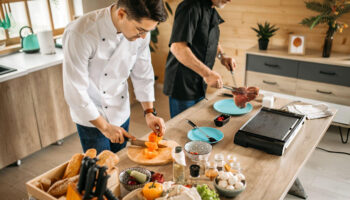
In a restaurant, a thick wall separates the noisy, profane chaos of the kitchen from the polished dining room. In a private home, there is no wall. Clients and their guests will wander over to the kitchen island with a glass of wine, ask questions about your reduction, watch your knife work, or casually invite you to join the conversation.
Learning to navigate this intimacy with poise is what separates career private chefs from short-term freelancers. Maintain warm, unhurried composure while reading the room carefully:
  • Know when to engage and when to disappear: Some hosts love having the chef introduce each course and share the story behind local ingredients; others want discreet, white-glove service so they can conduct private business or family conversations uninterrupted. Ask your host which style they prefer during your pre-event call.

  • Guard client privacy fiercely: Working inside private residences exposes you to family dynamics, business deals, medical diets, and personal routines. Never post photos of a client’s home, backyard, view, or dinner table on social media without explicit written permission—and consider using a standard non-disclosure clause in your service agreement for high-profile households.

  • Leave the kitchen cleaner than you found it: Wipe down every appliance handle, polish the sink basin, run and empty the dishwasher, take the trash out to the exterior bins, and leave zero lingering cooking odors. When clients wake up the next morning to a pristine kitchen and neatly labeled leftovers in the fridge, referrals follow automatically.

Setting Up the Legal and Operational Basics

Before stepping into your first client’s home, protect yourself properly. Form an LLC, open a dedicated business checking account, and secure general liability insurance (at least $1 million to $2 million in coverage) tailored to personal and private chefs. One accidental red wine spill on a custom limestone countertop or an unexpected foodborne illness claim can wipe out years of savings if you operate uninsured.
Build a compact, portable kit containing your trusted chef knives, instant-read thermometer, microplane, high-heat silicone spatulas, heavy-bottomed sauté pans, and plating tweezers. Residential kitchens often boast $15,000 ranges alongside dull knives and warped nonstick skillets; bringing your own tools guarantees consistent execution anywhere.
Leaving the restaurant industry does not mean leaving culinary ambition behind. When you trade the chaos of the ticket machine for direct human connection, disciplined pricing, and thoughtful menu design, private cheffing offers something rare in hospitality: a craft you can love for decades without sacrificing your health or your life outside the kitchen.